October 07, 2026
Drawer Organizer Desk Ideas: Desk Drawer Organization and Organizer Options

Introduction
A desk drawer can hold plenty of useful supplies and still be frustrating to use. Pens end up mixed with paper clips, small items disappear under larger ones, and empty space goes unused because there is no clear layout. If you’re looking for a drawer organizer desk solution, start with what you actually keep in the drawer rather than choosing a tray based on looks alone.
A practical setup gives everyday items a designated place, keeps less-used supplies out of the way, and makes the most of the drawer’s usable space. The ideas below cover a quick drawer audit, adaptable ways to group work and study essentials, and the basic organizer styles to consider. A few measurements and simple buying checks can help you choose a setup that fits both your belongings and your desk.
Start with a quick desk-drawer audit
Before buying a desk drawer organizer, empty the drawer and sort its contents into groups. Put similar items together, such as writing tools, paper supplies, electronics accessories, and personal items. Set aside anything that belongs somewhere else: a mug, a document to file, or a tool you rarely use may be taking up useful drawer space.
Next, identify what you reach for most often. Pens, sticky notes, or a charging cable used throughout the day should be easy to access, while spare supplies can sit farther back. Notice whether any items need to lie flat, stay together, or have enough room to avoid tangling. This gives you a clearer picture of the compartment shapes and sizes that might help.
Measure the drawer’s usable interior, not just its outer dimensions. Record the inside width and length, along with the height available when the drawer is closed. Check for handles, rails, support bars, or other obstructions, and note whether the drawer changes depth from front to back. These details can affect how much room an insert or set of trays can occupy.
Before-you-shop checklist
- Measure the drawer’s usable width, length, and height.
- List the item groups you plan to store.
- Mark the supplies you use most often.
- Note any rails, handles, supports, or changes in drawer depth.
Desk drawer organization ideas that make everyday items easier to find
Once you know what needs a place, divide the drawer according to how you use its contents. The aim is not to fill every inch. Leave some open space if it makes items easier to lift out or gives a frequently used group room to grow.
-
Separate small supplies into their own compartments. Paper clips, push pins, erasers, and sticky notes can quickly become a loose pile. Give each type a small section so you can see what is there and put it back without sorting through unrelated items. If you have only a few of one supply, combine it with a similar group rather than assigning a large compartment to it.
-
Keep writing tools in an easy-reach zone. Put the pens, pencils, or markers you use most near the front or on the side of the drawer that is easiest to reach. Keep less-used colors and spare writing tools together elsewhere. A long, narrow compartment can keep pens from rolling into other supplies, but a simple tray arrangement can work too.
-
Give electronics accessories a separate area. Charging cables, adapters, earbuds, or small device accessories can mix with stationery and make both groups harder to retrieve. Use a distinct compartment or small tray for these items. Keep loose cables together, and avoid putting them underneath objects that you need to move every day. If a cable is used regularly, leave it near the front rather than burying it at the back.
-
Reserve a spot for personal or task-specific items. A student might keep a calculator or ruler together; someone working on creative projects might group a few small tools used for a current task. Use a compartment that suits the items’ shape, and review it when the task changes. This helps prevent one-off supplies from spreading across the whole drawer.
-
Arrange by frequency, not just by category. The most-used items should be easiest to reach, even if that means keeping one category in two places. For example, put a daily-use pen at the front and store spare pens with backup supplies. Choose a layout that makes putting items away as straightforward as taking them out.
Example layout: Imagine a single drawer divided into three zones: pens and a notepad at the front, small stationery compartments along one side, and a tray for charging accessories at the back. A separate open section can hold a calculator or the supplies needed for a current project. This is only a starting arrangement; adjust the zones to match the drawer and your routine. Keep unused compartments empty rather than finding objects to fill them.
Common desk drawer organizer options
A desk drawer setup can be as simple as a few containers or as structured as fitted compartments.
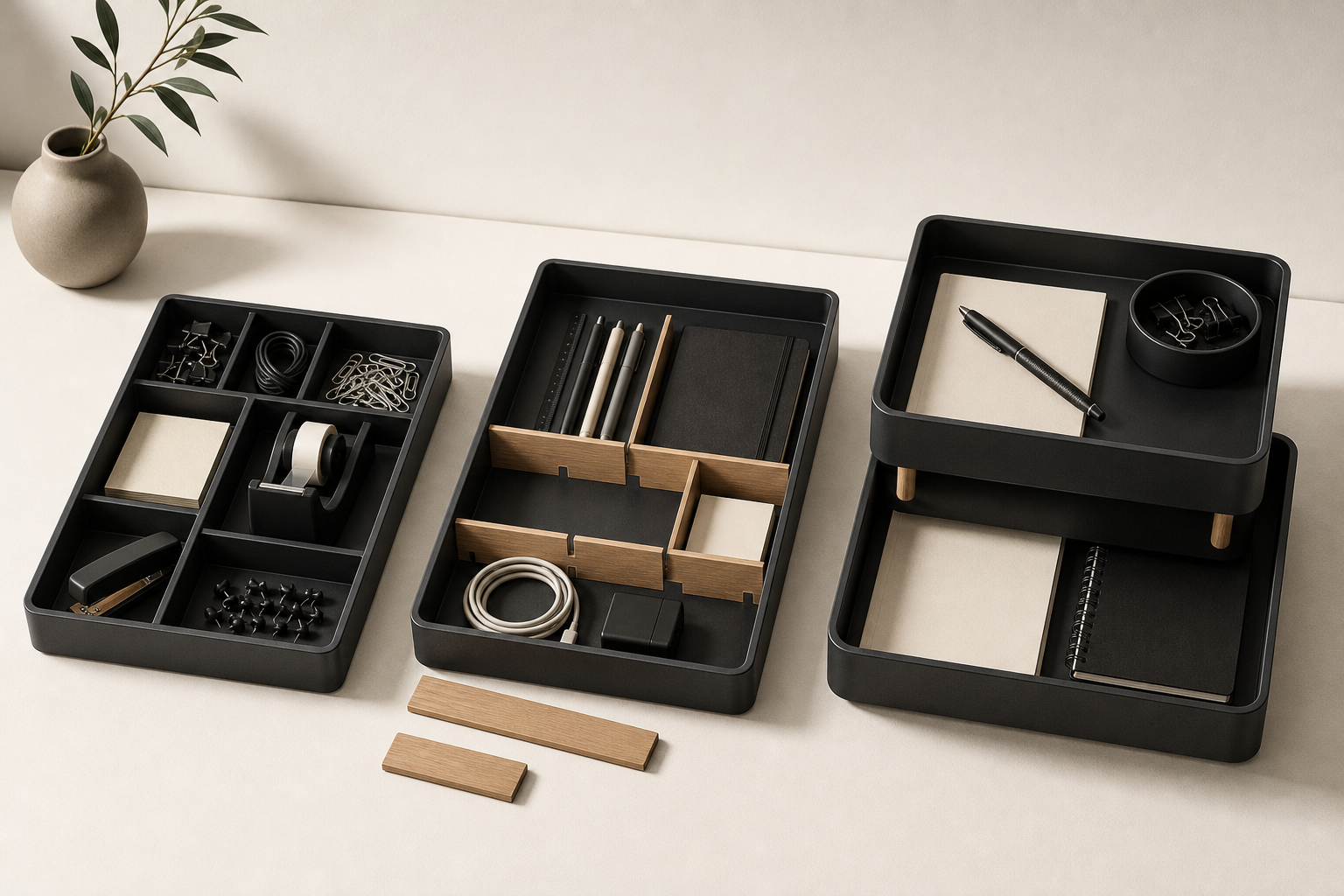
Choose based on what you store and how often those items change, rather than selecting the option with the most sections.
| Organizer type | Suitable for | Flexibility | What to check |
|---|---|---|---|
| Fixed-compartment tray | Small, loose items such as clips, erasers, or USB drives | Low; compartment sizes stay the same | Whether the sections fit your items and the tray fits the drawer |
| Adjustable dividers | Grouping items of different sizes, or storage needs that change | High; sections can be repositioned | Whether dividers stay in place and can be adjusted to the drawer’s width |
| Stackable trays | Separating categories when the drawer has usable vertical space | Moderate; trays can be rearranged or removed | Total stacked height and whether the drawer still opens and closes freely |
| Simple boxes or cups | A few everyday supplies, larger tools, or an inexpensive trial layout | High; containers can be moved or swapped | Whether containers slide around, tip, or take up too much room |
Fixed trays keep small supplies visible, but narrow sections may not fit larger tools or changing collections. Adjustable dividers adapt, though check that they stay in place when the drawer moves. Stackable trays add layers when the drawer has usable height; measure clearance and keep daily items accessible.
Boxes and cups let you test a layout or contain irregular items, but may slide unless they fit closely.
Whatever type you choose, prioritize dimensions, materials, stability, and ease of cleaning over compartment count. A well-fitting smaller organizer is more useful than sections you cannot use.
How to choose an organizer that fits your desk drawer
Before buying a drawer insert, measure the space it needs to occupy. Check the drawer’s interior width and length, then measure its usable height. Drawer fronts, runners, handles, or other features can reduce the clear space, so measure the area where the organizer will actually sit. Compare those measurements with the organizer’s listed dimensions and leave enough clearance for the drawer to move without catching.
Next, size the compartments around the objects you plan to store. Lay out the items first, including larger tools, charging accessories, or stationery that may need a longer section. A tray designed mainly for small supplies can waste space if your essentials are bulky. If you are unsure, sketch a simple layout or use temporary containers to see how much room each group needs.
Consider how stable your routine is. Fixed compartments can work when the same small items belong in the drawer every day. Adjustable sections may be more practical if you rotate between study supplies, craft tools, or work accessories. Simple boxes offer another flexible option, though check that they fit snugly enough not to slide when the drawer opens.
Before ordering, check the seller’s current listing for dimensions, materials, care instructions, price, and availability. Product details can change, so rely on the listing rather than an old image or description. If the page does not explain how the organizer should be cleaned or whether its sections can be adjusted, confirm those points with the seller.
A useful final check is to compare the organizer’s footprint with your measured drawer and the objects you have grouped. The right choice should fit both without forcing you to leave essential items loose or make the drawer difficult to use.
When shelf and wall storage can complement drawer organization
Drawers work well for small items you use regularly, but they do not need to hold everything that belongs near your desk. Large notebooks, display-worthy supplies, or tools that take up too much drawer space may be easier to reach on a nearby shelf or wall. Keep the drawer focused on items that benefit from being tucked away, and give each additional storage area a clear role.
This kind of shelf and drawer organization can reduce crowding: use the drawer for small essentials, shelves for larger items, and wall storage for suitable tools or supplies you want visible and accessible. A wall-mounted pegboard can be one option for workspace items, but it is not a drawer organizer. As the publisher of this article, SKADEAS offers pegboards and accessories; check its current product information before choosing a setup.
If wall storage suits your workspace, Get info about SKADEAS pegboards and accessories. For a broader look at shelf choices, see this shelf organizer guide.
A simple setup routine to keep the drawer organized
With an organizer or containers, set up the drawer:
- Empty and group the contents. Group similar items, such as writing tools, charging accessories, or craft supplies. Remove anything that does not belong.
- Place items by frequency of use. Put everyday essentials near the front. Move occasional-use items toward the back, while keeping them easy to reach.
- Fit the sections to the objects. Position dividers or containers around each group. Avoid large gaps that invite unrelated items to collect.
- Test the drawer. Open and close it fully. Check that containers do not catch, tip, or shift into the drawer’s path. Adjust the layout as needed.
- Reset when your needs change. Remove items that no longer belong and reposition adjustable dividers when your routine or supplies change.
To maintain the arrangement, return each item to its assigned section after use. Reassess the layout if a category starts overflowing. The goal is to make items easy to find without making the drawer harder to use.
Conclusion
A useful desk drawer setup starts with what you actually store, not with the organizer that looks most appealing. Audit the contents, measure the drawer’s usable space, and choose compartments that fit your everyday items. Arrange them, then test the layout during your normal work or study routine; adjust anything that feels awkward or quickly becomes cluttered.
Keep complementary storage purposeful. A shelf or wall organizer can help when the drawer is full or frequently used items are easier to reach nearby, but it does not need to become another project. If wall storage would suit your workspace, explore SKADEAS pegboards and organization options.